The SMIDSY Effect: Why Drivers Don't See You (And How to Fix It)
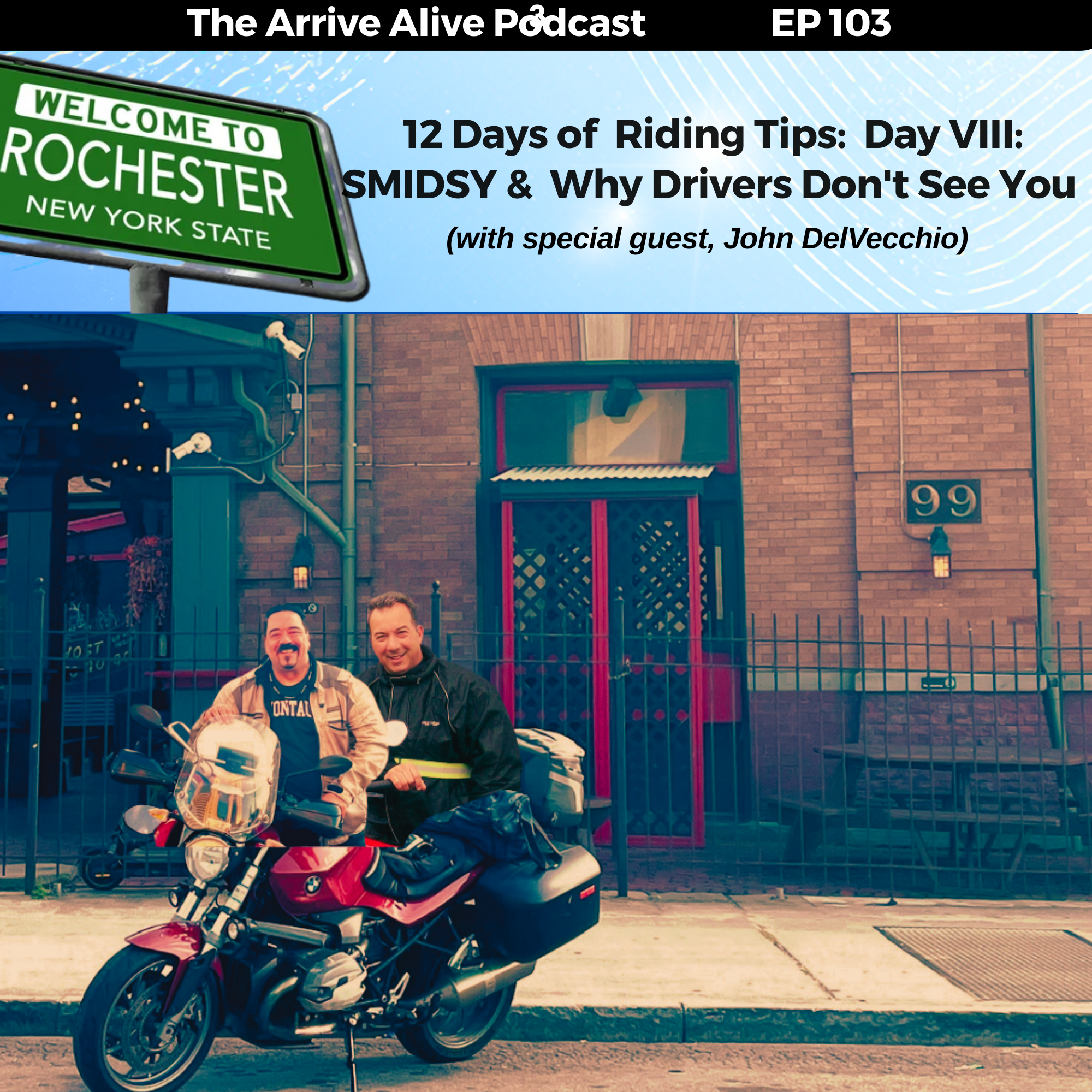
In Day 6 of the 12 Days of Motorcycle Safety, we welcome back returning guest John DelVecchio, a motorcycle training expert and author from Rochester, New York, for a critical discussion on visibility and being seen on the road. We dive deep into the "SMIDSY" phenomenon (Sorry Mate, I Didn't See You) and explore the science behind why drivers often miss motorcyclists—including eye movement blind spots called saccades, convergence invisibility, and windshield zoning. Listen and share with friends and family who ride.






Follow Jon DelVecchio
- https://www.streetskills.net/
- Jon's Presentation on YouTube: https://youtu.be/70PB6HEhGEk?si=njWJzB0kyBRYFAM1
- Another Helpful Video: https://youtu.be/eqQBubilSXU
---------Support Our Sponsors and Partners----
The John Haymond Law Firm. Their attorneys ride and have won over $1.5 Billion dollars for their clients! IF YOU GO DOWN, THEY WILL PICK YOU UP!! Visit their site here, or call them at 1-800-HAYMOND! Print their business card here.
All right, we're here with day eight of the 12 days of motorcycle safety tips.
And, you know, I feel like I'm Johnny Carson. We have a guest returning, but he's
not promoting a book or a DVD series. We have John Delvecchio from Rochester,
New York. John is, you may remember, he is a business arts teacher, a driver's ed
teacher. He's done videos and training programs at Lake George and all over the
Northeast and probably the country. John, thanks for joining us today. It's great to
be here, Len. Always good to see you. That is the exact perfect answer. John, what
bike are you riding these days, by the way? I got a 2014 GS.
I love this thing. Oh, very nice. I got a 2014. BMW, R -1200 R. Yeah. And my
daughter, I don't know if I said. R -12. You have the same, a 14? Yeah, I bought
Don Island.
They're just such rock -solid bikes. I mean, I haven't had a need to do anything.
How many miles you got on this? I ride it and I have fun. I got about 45 ,000
something like that. I just turned 50 ,000 like two months ago. So very similar. All
right. So today we're going to talk about, we're going to talk about being seen,
but also not like so much as reflective clothing and things like that, but how to
avoid like people what's called hey sorry mate I didn't see you and also like how
to read traffic patterns and and drivers okay so let's talk about first you know
what would you say how do we avoid the hey I didn't see you because there's a lot
of drivers out there that they're nice people that could be our you know could be
my mother for all you know for all we know but But, like, you know, we're one
little red light or we're one light and people looking at, they're looking for big
things like cars and trucks. What would you recommend? What would you tell people to
kind of increase your chances of being seen as a moving object to pedestrians and
drivers? You know, I will defer to the AMASAF,
the most recent incarnation of the BRC curriculum, I ended,
I stopped teaching the MSF courses probably in 2017 or whatever,
but I just got trained in the, in the latest incarnation of the curriculum right
when I stopped doing it. And they have this term called presentation, okay?
So the best starting point that riders should be thinking about is the concept of
presentation. Now, unfortunately, there's so much in the MSF BRC that things can just
fly over your head and you don't catch it. You turn around, you go to the bathroom
quick, you miss presentation or whatever it is. Presentation basically means we force
the issue to put our bike in a position where people see
and I'm going to get a bigger distance between me and the other cars and then make
sure the cross traffic sees me behind it. Okay. I mean, like that would be an
example. I think in the curriculum it's pulling up to an intersection and making it
known you're there before you turn right or something like that. So motorcyclists
have to really change a switch in their head. When they're In a car, presentation
works because people see a big car. We blend.
And it's very cliche for what they would teach in these basic courses. We blend too
much into traffic. We're small objects. And so the first thing we have to do is
think almost in a 360 degree way. Are these other people that are moving right now
on the roads around me? Can they see me? That's the number one thing that I think
we need is a starting point. Okay. Positioning yourself to be seen, Ladd.
You know what I mean? And in the last 10 years, John, we've had a phenomenon
probably, you know, since the invention of the iPhone, like 10 years ago they might
have seen you. But now where distracted driving comes into play, does that even
enter your mind? Are you
tricks of the eye. Okay, then I'll just quickly mention a little bit. Yeah, let's
talk about that. They're not, it's not because we're distracted by a phone or
changing the radio station. They're visual problems that make it hard for us to be
recognized beyond the presentation, beyond putting us in a place where we're more
easily seen, okay? Like, you talked about the Smidzee, okay? Sorry, mate, I didn't
see you. It is the best video I can possibly suggest people go find on the
internet for any rider that hasn't seen it. It's a must watch. As a matter of
fact, I had a former student. He's now my mechanic on my GTI. He works on Porsches
and Volkswagen. Kids 22 years old. He got his license. I said, I don't want you
getting on this bike before watching this. And I had to explain to him about the
contrasting background. So again, someone, let's just say you or me are not on our
phone, but there's a motorcycle. A motorcyclist is riding.
And if there is not contrasting background by our circumstances or a forced I'm
My goodness, I wish I could have just got to that kid and said, watch this video.
You know, he was in the suburbs, okay? This is a busy road. This is like a where
there's shopping centers and things like that. Yeah. You cannot take for granted the
left turning vehicle in front of you. You have to go through every intersection to
the right or something, and you have to look for that car. They're going to turn
left in front of you. And no one told this kid or he just was having too much
fun to think about it. Oh, I'm sorry to hear that. Yeah, it's just, you know, when
you're in traffic, you're not in a car and it's not a place to play games. You
really do have to have your head on the swivel. So the smithy, sorry, mate, I
didn't see you, they show a couple different things in there. But the key in there
is the contrasting background. Yeah. So,
and I'm not scared doing 124 miles an hour on that road because nobody's around.
What I am scared of is riding back to my parents' house, you know, on a suburb of
Long Island where you have, you know, people shopping. And I go through every
traffic light with my hand on, you know, the front brake and looking around.
I also have, I don't know if you still, if you, I don't know if you told me
years ago, you used to have a bike, but my, my bike has the pulsating headlight,
which used to be popular years ago. I think they fell out of favor for some
reason. I had one of my V -Strault. I had to take it off. Really? Yeah, the light
sensor was acting weird. I was driving at night. It was flashing on and off. I'm
trying to use my own lights. Oh, at night, they're supposed to shut off. Well, it
was the sensor was off. Right. People were getting, you know, and that when people
come towards me, I wasn't crazy about it, because again, the flashing light, just to
give you another little tidbit here, when I did this presentation at a BMW
dealership in 2015, I learned a lot about our eye movements and things along the
way. And, you know, Keith Code talked about this stuff a lot in Motorcyclist
magazine or whatever, but there's something called a circade, okay? A cicade is when
we just move our eyes quickly with a dart around looking for things to focus on.
Okay. Now, when you are at a stop sign in your car and you look left,
right, left, you're moving your eyes. Well, when you move the pupil of your eye to
focus, it's in what's called a circade. It's of temporary blindness. Okay.
And that's why you can't even see a UPS truck sometimes when you look for it on a
motorcycle car you got to you have to pause to let your peripheral vision pick up
the movement well here's the thing when your eye pupils are darting around looking
for things and you go blind when they switch around um you can't even see a flash
of light in a circade so you and me go blind more than we think we do but it
happens so fast now in traffic, we can have problems with secades.
And that, you brought this up earlier, eye contact with people that might be on the
phone when you talked about that. They used to say in driving instruction, you know,
when you're at stop signs and out four ways in communicating with other drivers, try
to make eye contact with them. Well, you know today you could be talking on your
Bluetooth on the phone, look straight through somebody. You could. So the value, if
you're looking at someone at a cross street and their head stops at you,
eye movement of the circade. So I'm not a doctor, but these are the things that I
kind of learned over time. And so we have to be patient when we're driving because
think about how terrible it would be for you and me to rush a stop sign just to
pull out in front of a motorcyclist because we weren't looking for them too. So
that has a lot to do with what I think people can do.
Okay. And there's a couple other things real quick that I'll point out.
the
disrupt the convergence of two objects. Okay? So you might,
let's say you're, you're driving. I mean, like a video game, like the old, like,
you know, think about the convergence. So you're driving north on a road. Towards an
intersection. Someone's driving west. And you're going the same speed at the same
rate. Okay. And you're arriving at the stop sign at the same time. Oh. Okay. What
happens is they never move in your line of sight due to convergence.
So you may notice this happening sometimes where you're approaching an intersection
when someone else is and they just stay in the frame of your vision relative to
you as you converge together. So fighter pilots would lose other pilots in warfare
in this Convergence invisibility. So if you see that you're in a convergence
situation with a vehicle, you disrupt it. You slow down or speed up to create that
contrasting background. And then, of course,
along with the convergence is a problem where there's this thing called windshield
zoning. Okay. So when you're driving in your car, you're looking out the windshield,
right? well you don't look to the
I think it's a practice, and I was watching, there was a video on YouTube on how
to kind of, you know, practice the smithy or practice the eye movements and you're,
and so you're not as blind, you know, for those split second. Let me ask you two,
at least two more quick things. Number one, because, you know, one of the things
that I ask a lot of the guests, and they have to usually be of a certain age,
but I ask them, do you remember the TV show I dream of genie. Thankfully, most of
the people say it is, yeah. So I say, what part of your, of your, of your skill
set needs the most to work? 80 % of the time, it's, it's cornering, and then
sometimes it's swerving, believe it or not. So my question to you, who you've
authored the book on, on cornering, but is there a rule of thumb of when,
you know, I'm not cornering like in a race setting, but when to, let's talk about
breaking versus swerving.
Is there a rule of thumb when, which is appropriate, you know? So, so this is,
this is in traffic or a corner? Well, let's put it like emergency procedures.
So there's something in, like you might be able, you might not be able to stop in
time, John, but it's why it's swerve.
That's, that's really the crux of it. first of all, in a copy.
thing, but it fell out of his the pickup truck and it was right in my way and I,
I wouldn't go of that, I was on the Cross Island Expressway, which goes north and
south on the island, and I probably had to swerve it going 40, 45 miles an hour
to miss it. And let me tell you something, my heartbeat went from 72 to 172.
And that's the other thing is you got to watch out, you know, what is in front of
what is what what what are they carrying in front of you that might you know
escape from there yeah you know sometimes uh you just can't avoid things i got deer
out here and uh oh yeah i was i got a gt i'm a pretty low car i'm used to
having many vans pickup truck stuff like this and um i knew that there was a deer
strike ahead of me based on what i saw in ways it was an accident with a car on
the shoulder i'm like driving to work i go All right, let me, I see the car to
flashers. I go to change lanes. I struck the deer carcress and damaged my car,
okay? Oh, my gosh. So sometimes you can't see the thing, you know what I mean? And
so swerving, swerving is you got to be careful with it.
You don't want to swerving downcoming traffic. You don't want to, you know, talk to
front end or something like that. But, but yeah, these skills are really essential
in traffic. And, you know, that's why when I see people like Moto Jitsu and stuff
like this, Greg over there, they really tell you to work on these low -speed skills
because most people don't really want to go in a parking lot and work on low -speed
skills. You know, it's just not fun, you know, and I'm guilty myself. You know, I
have to kind of force myself to practice those skills. But in a corner, the book
corner and confidence there where I do talk about these light swerves or oscillations
in the curve to kind of, We can position ourselves to avoid certain things like tar
snakes. But it's motorcycling is, it's even harder to teach than driving a car
because in a car I'm sitting next to it. You know what I mean? On a motorcycle,
even with headsets, it's really difficult to teach someone how to ride a motorcycle,
you know? But you said the magic word. So, you know, I run the two -wheel Tuesday
night here. And it's, and and it's nothing against women, but we don't get that
many women until the weather starts getting above 72 or 75, and then they come out
in droves. But the guys are always there, right? And there was a couple of days
this summer where we had like 35 % of the 250 people that usually come were women.
And that was nice because it was nice to just meet women, whatever. But we had a
few girls women, I should say, they're in their 20s and 30s,
Was I wrong or right? And how should people approach tars and eggs, both in a
straight line and on a curve? You know, this is really important.
And I think a lot of people, when they're in a corner, they go into the corner,
they see gravel. They panic, right?
And a lot of times if you just don't make a dramatic speed change or steering
change, you get a little, you get a little crooked through those slippery surfaces,
but you usually come out on top. You know what I mean? Yeah. I think when people
see gravel or see something slippery, they can panic,
which causes them to behave in a predictable way. They just don't know in
unpredictable ways. What you have to do is you have to kind of practice and
rehearse in your mind what you would do over a slippery surface. For example,
when I taught at New York Safety Track a couple of times, I did my curriculum
there. And I set up, I took road line striping tape.
It's like this metal tape you can construction people use to outline the lanes.
Okay. And I would put those in the apex of turns and things like.
I mean, a Tarsnake, Len, could tuck your front tire and put you down just as easy,
okay? But I have found when I've hit major potholes leaned over or when I've hit
something, if I just kind of steady the course, I usually turn out better off. Now,
if, now modern bikes, and then I'll let you go, modern bikes have, you know, AW,
not ADU, I'm thinking of Amazon on web services.
And they're one of my clients in my day job. That's so funny. Modern bikes have
ASC, automatic traction control, and they have all the different, you know, rain
riding and dry riding and all that stuff. Does that come into play, what'd you say?
So I am huge on having as much tech on the bike as you can afford,
okay? All right. I'm the opposite. Go ahead.
reflexes, you know? Sure. And so even with all my ears of writing experience, I
mean, let's face it, we're humans. We make mistakes. And, you know, that's, my 2014
lacks a lot of the modern, like the cornering ABS, where my KTM,
my 790 Duke had and I sold that. Yeah. So, you know, that's one thing that I am
looking forward to in a couple years when I do upgrade because I think that
especially for the young people out there that are just getting started or any new
rider you want to put more odds in your favor of a newbie mistake costing you big
and i i think you can still learn how to be an excellent rider with those aides
you see that's true yeah guy in my garage has like a 2021 rt and that seems to
have the good combination as the cornering abs as a few more you know, variables in
there, but not going over.
with the motorcycling podcast, you know, a Rive Alive podcast. I know you've been
doing it for a while. And it is kind of a labor of love. You know what I mean?
It's very difficult to hold people's attention and to continue to make these
podcasts. And so I just want to say, thanks. I really appreciate you doing this.
And you're reaching more people probably than you think. And, you know, you're one
of the podcasts that I make sure I listen to when I'm coming out. Oh, thank you.
Because you're a heck of a great guy. Thanks. All right. Well, all right.
All right. I'm going to pause recording once.


