Good Riding Tips for Bad Roads and Conditions with BMW MOA Editor, Wes Fleming
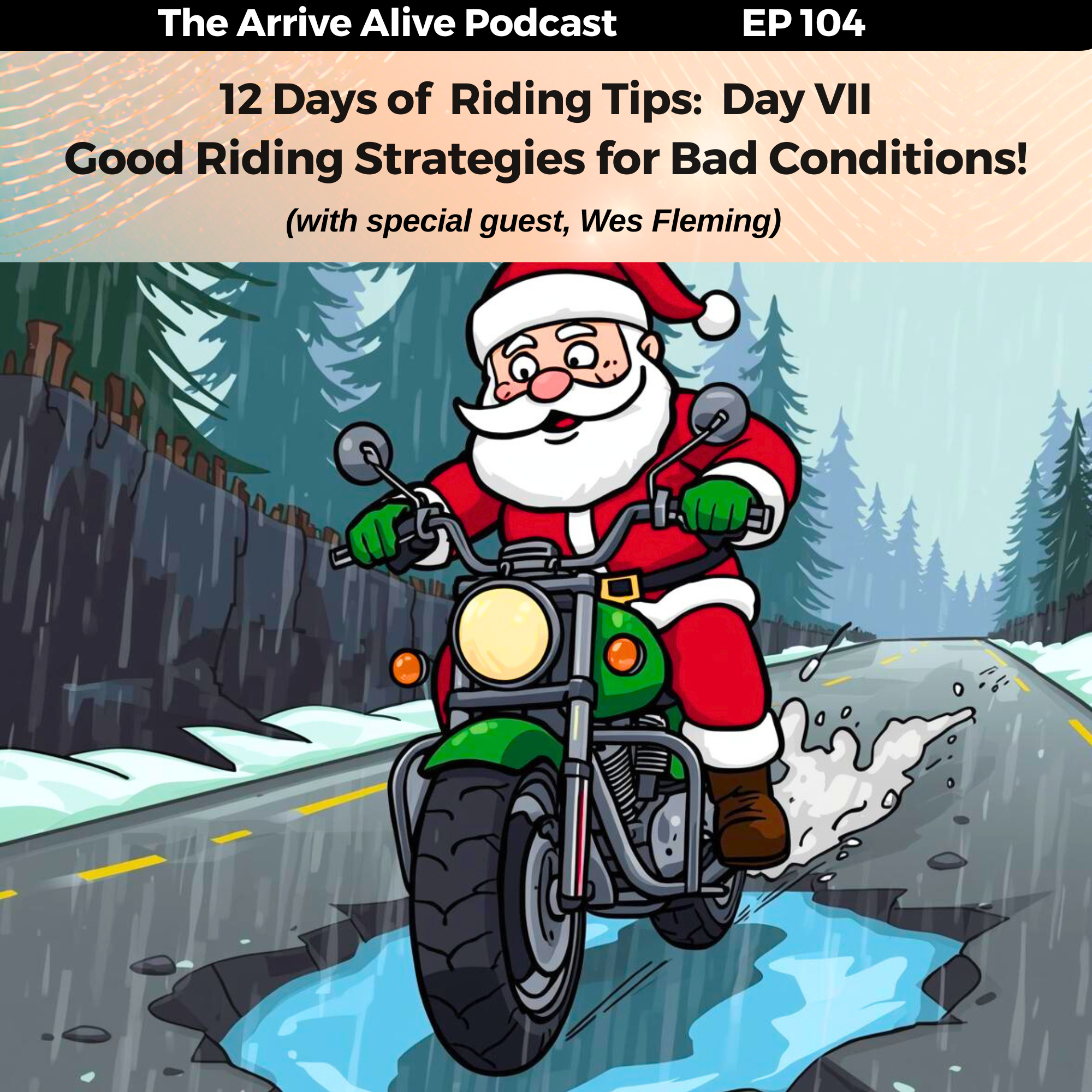
cold winds, rain, gravel, ice, while not fun at all can be dealt with successfully with the right mindset and technique. Today, BMW MOA's Wes Fleming admits to riding hundreds of miles in 6°F weather and also tells us strategies for staying upright and warm and protected in rthe worst of conditions.
Whether you're commuting year-round or just want to be ready when the weather changes on you, these tips will make a real difference. Stay safe out there and arrive alive.






Useful Stuff!
Paul Bachorz Rider Training Rebate Via BMW MOA
A great program for riders of ANY motorcycle, regardless of brand. Get a rebate of up to $200 on most safety courses you take. More info:
https://bmwmoaf.org/paul-bachorz-rider-safety-training-rebate/
Join the BMW MOA
https://bmwmoaf.givingfuel.com/memberforces
Wes Fleming's Surf Band Agent Octopus!
http://agentoctopus.bandcamp.com
Wes Fleming's First Appearance on our Show!
https://www.arrivealivepodcast.com/wes-fleming-shares-mental-and-physical-healing/
---------Support Our Sponsors and Partners----
The John Haymond Law Firm. Their attorneys ride and have won over $1.5 Billion dollars for their clients! IF YOU GO DOWN, THEY WILL PICK YOU UP!! Visit their site here, or call them at 1-800-HAYMOND! Print their business card here.
Hey, welcome to episode 104 of the Arrive Alive podcast and also day seven of the
12 days of holiday riding tips that you can use for the whole year. Now,
before we get into the episode, quick reminder, this show is brought to you in part
by the good folks over at the Heyman Law Firm. Should you go down and you need to
get back up and be represented by a high -quality law firm, call 1 -800 -H -A -Y -M -O
-N -D, and mention it your friends of the show. Now, this show is going to be cool
because we have Wes Fleming, who during the day, he works at the BMW Motorcycle
Owners Group of America, and he's been all over the country on his BMW for work
and pleasure, and also by night he's in a surf band, and they'll be playing in New
York City area in May, so more on that later. but Wes, welcome to the show.
What's the coldest weather you've ever ridden in for any length of time? I'm not
proud of this, but the coldest I've ever ridden in is six degrees. Holy four. It
was at a time in my life where I did not own a car. Okay. And I had to go out
of town on business, and it was a freak occurrence. We got snow and ice that they
weren't expecting in the forecast. So I had to ride almost to, however far far is
from Wilkesbury, Pennsylvania, back to northern Virginia in between 6 and 20 degrees
that day. You're kidding? No. What bike was this?
Did you have like an arrow -stitched suit? I mean, what were you wearing? I had a
Honda Shadow, and I was wearing, I was wearing decent gear. I had on a textile
jacket that was waterproof and textile pants overpants that were waterproof. But it
was, and I had on, is a company called Witter that used to make electric gloves?
Yes. And so I had those. And I basically, I just pulled over every 30 or 45
minutes when I couldn't stand it anymore and warmed up in a convenience store or
gas station or something and then got back on the bike and got another 30 miles
down the road before I stopped again. It was miserable. So, Wow. That's it.
We'll have to off to that. Wow. Okay. So let's, back to modern times, you know,
there's been so many advances, right? And a lot of the hikers, I know, like,
there's a lot of hiking gear that also keeps you warm. Like, is there any type of
new fabric or fabric that you're seeing that really does a good job that people
can, can buy? Or is it just the basics? Layer, layer, layer. I think there's The
newer membrane that manufacturers have been using called Hypera that is waterproof and
windproof. It's a competitor to Gore -Tex. So I think that's done a lot of kind of
democratization in the gear industry across a bunch of different sports.
But yeah, there's a little bit of fleece, a little bit of, you know, something to
stop the wind, something to hold in the warmth and something to keep the water out
and then layers is really, and staying away from cotton. You know,
you don't, especially next to your skin, if there's any chance that you could sweat,
you don't want to have cotton next to your skin. No cotton. No cotton. Yeah. No
cotton. Wow. Cotton holds onto moisture so it doesn't dry. What you want is wool
that absorbs the moisture, but it doesn't feel wet. And it just makes a huge
difference, those base layers. And there's a lot of synthetics out there now that
are really good, too. You know, a lot of the guys, some guys now, you know, Amazon
has everything, right? Like, I did have that electric vest years ago. It was
probably 60 pounds ago, unfortunately. But I used to have to be tethered,
you know, to the battery. But now on Amazon, first of all, these coils are so
thin, number one, and the battery technology is so good that I think is, yeah. You
know, do you, like, do you have anything or do you know anybody that has those
right now? I did just this year in December, yeah, probably late November, I got a
pair of battery powered, heated gloves because the bike I've been riding all year
doesn't have heated grips. Okay. And I didn't want to install them. It's a vintage
bike, and I didn't want to go through all that. So I just got there,
I think they're called savior heat. And it's just, it's pretty standard. The seven,
little seven volt block batteries, you plug them in. If you put it on high, it
lasts for about two hours. If you keep them on low, it lasts for, you know, five
or six hours. Most of the time I would start on high for about 10 minutes and
then switch them to medium. And that was, that was good enough. They make anything
like electric for the head, though? Are they making like skull capture?
the head warm. I think you're right, because I know Scorpion makes some snowmobile
helmets and they used to sponsor us some years ago, but they're happy to come back,
Steve, I'm just kidding. And I know like the core, right, because it's really your
hands, your feet, and even your head and your neck. Like, you know, I have a
little extra padding, so I don't worry so much about that, just from a, you know,
also want to protect it from, you know, from crashing and stuff like that. Right.
And then the wind and then the snow, you definitely don't want to be, you know,
that's a whole traction issue. And let's talk about trip. Well, let's talk about, we
had this ride like about a month ago up in, are you a Lego guy? Did you play
with Legos when you were kids? Of course, yeah. Okay, so there's this place called
Legoland. It's about 60 miles north of the city, right? And so we had like 40 guys
leave from Fort Lee, New Jersey, and we go up there. And, you know, it was like
mid -40s, but boy,
it was windy that day. And my bike is like, I think, 512 pounds, and I got
another 280 of me. And then plus the side case is another 40. And every time I
would go past a car or truck, I swear, I don't know if I got blown into the next
lane, but I definitely got blown from one lane position to another. And of all the
safety, I forgot how to deal with that. What is the best way to deal with wind
like from the side and even other places? I found that anticipation is going to be
the best thing for me, especially with semis, because when you come, when you come
out of that bubble, if it's windy outside, you come out of that bubble where you're
not beside the my anymore, all of a sudden all that crosswind is hitting you. So
what I, what I tend to do is I will wait the peg that's on the side that the
wind is blowing from. So if the wind is coming to me from my left, I'll wait the
left peg just a little bit in anticipation. It kind of leans the bike a little bit
to the left.
And then when the wind comes, it kind of stands you back up. But really, the only
thing you can do is anticipate it and practice and pay attention while you're
dealing with it. And then it becomes kind of second nature. But a 50 -mile -an -hour
wind gust is always going to be a surprise, whether your bike is a full -faring
gold wing or a minimalist, you know, Honda Rebel. You know,
I think that's what it was the surprise, because when I'm around semis or even
bigger kind of trucks, I'm very aware. But this was kind of coming around a bend,
you know, in like the Kipsey area in New York. And it was just like very, very,
very, very, very, very sudden now. Yeah. So you were talking about the sand on the
road in Richmond. We have salt. Everybody's like the, you know, the guys that are
going riding right now in New York City, they're definitely making sure to hose
their bike down from the salt. But, you know, today's bikes. I mean, I see these
kids, kids, you know, they're in their 20s and 30s, and they have these Yamaha MTO
-7s and these new Kawasaki's, and they have so many riding modes,
right? Like, my riding mode on my bike is on and all, although I do have the ASC,
right? So it's not that old. It's, you know, but I think I just, I don't even
think I even turn. I think it's always on and I think I can turn it off if I
need to, if I'm correct. So I don't even have to worry about it, but if you're
like, you know, if you're a kid and you have one of these bikes, it's part of
like learning to ride knowing what mode you should be on based on, you know, maybe
not great road conditions. Yeah, so you're right. We end up with a lot of sand.
What they do in central Virginia where I live is if it's not raining before a
storm comes in, they'll treat the ground the roads with a, it's kind of a beet,
it's some kind of beet and salt mixture. Okay. A liquid, and that clings to the
road surface and helps break up the ice as it forms. But then once it starts
snowing, it's snowing, they put sand down. And the snow melts away and takes a lot
of the sand with it. But we end up with a lot of sand in the middle of the
road, which is where a lot of motorcycle riders tend to stay in curves,
where typically what we have to worry about is oil or gravel that builds up in
curves. So when I'm out riding in the winter,
especially after a storm, after the sand, because it won't go away until we have a
big heavy rainstorm. So I try to remember to stay in One, you know, you break the
lane into three parts, left, middle, and right. And I try to stay either to the
left or to the right of that strip of sand. And then pay attention when I'm,
you know, have to cross it. I treat it like a, you know, like a railroad track or
a crosswalk painted line. Just as this very slippery hazard that I have to be
constantly aware of. And, you know, really sharp looking in turns,
slow and down way more than I need to to make sure that I'm on one side of the
sand strip or the other, and not, especially in a curve, not crossing it, because
your rear wheel will step out on you faster that you can possibly imagine. So does
my ASC or these other riding modes and these newer bikes, I I guess they're
considered safer in conditions like this, but would you say? And then the other
thing is, is there a chance of people say, oh, you know what? The setting of my
bike will take care of it. I don't have to be as aware. Do you think there's a
danger there, too? Yeah, I think that's a huge danger. And it's a really good
observation on your part because especially if you've never ridden a bike that
doesn't have any lock brakes and doesn't have automatic action control and doesn't
have all of these computerized safety features, you might not know what to do when
they fail, which is a great reason to take a refresher course on somebody else's
bike, like an MSF class where everything is on those 250s and it's easy. And, you
know, it's easy to laugh at it, but it really makes you think about what you're
doing and very few of us remember to go practice, you know?
And you might not be able to find a huge pad of sand to go practice your quick
stops on or curves. But practicing those maneuvers will keep your skills front of
mind. And I think that's what really helps people. But yeah, your traction control
will help a little bit when you get into a situation like that where you're on a
little bit of gravel or a little bit of sand or you hit a little oil patch. But
the real danger from it comes from when your rear wheel starts to slip.
And then you get back on clean pavement and it hooks up. And that's when you end
up getting tossed into a high side if you're not paying close attention. Yeah. You
know, there's that YouTube channel, that famous YouTube channel that what's that
famous turn in Los Angeles that the guy has that webcam you know the one I'm
talking about where everybody I do I don't remember what it's called I watched I
watched that in the the bridge in North Carolina that all the trucks get on that's
a great channel yeah those two are great and you know as much as I love the
fireman guy I can't watch him that much because like he shows the actual crashes
and you don't want to be seeing that too often as a as a guy you don't want to
be but that is funny and now in Richmond you probably don't have this issue but
you've ridden all over the country and you know my my apartment here is about 720
square feet in Manhattan and I think I think we have potholes in New York City
that are about the size of my fucking apartment right Right. So, you know,
now, you know, I have the telilever, so which I don't have like the traditional
springs. But, you know, I'm not like everybody else. And if you see a big pothole,
you know, you have two choices, right? Try to swerve around it or maybe hope it's
not so deep that it's going to fuck you up and screw the bike up. You have any
recommendations for people there, especially that live in cities that tend to have
these big potholes? Yeah, the big danger is your rim gets bent, right?
And then you'll lose all the air out of your tire in a hurry. Hopefully, you know,
you don't have a catastrophic tire failure, but it can't happen.
One of the things that I do, and it gets a little tough in the city because there
usually tends to be traffic in the city, but to give a little more following
distance so that I have more time to react when I see a pothole. And of course,
I'm scanning up and I'm scanning down at the same time trying to make sure that I
don't hit a giant pothole where it's that frost heave process.
You know, the water gets down in there, freezes, expands, cracks the pavement, else
goes away. And over a period of time, it just gets worse and worse and worse. One
of the things that I do is I make a note to where they are and I call the
Department of Public Works and report it, you know, that's especially effective in my
little neighborhood where I live.
But yeah, I mean, you slow down, give yourself more sight distance. And if you
cannot, if the pot a hole has water in it, don't ride through it because you don't
have no idea how deep it is. You have no idea how deep it is. I get, I'm on a
first name basis with the potholes in my, you know, I call it. And you know what
I also call them? I call them by how long I'll be in the hospital for if I get
him. You know, oh, that's a two week here. Oh, that's a three day. I should be
okay with that one. But one thing I will say, and Mike Bloomberg started this too.
And he was say whatever you want. I mean, he would say, like one day he was a
Democrat, the other day he was Republican, then he was an independent, but he
started the 311 program, which I don't know if you know too much about, but it's,
yeah, so you call 311 instead of 911 for anything other than an emergency and then
use the first one to make an app out of it. So what you do is you have the 311
app on your phone, you take a photo of the pothole and then you upload it and
then they must fix it within 48 hours or you can sue them like if you get hurt
in it you know type thing or they're more legally liable I don't know if like you
know if they don't fix it so and it's a way to track it as opposed to say oh I
called then you guys never freaking fixed it so that's one of the he's still alive
I think but I don't know what he's been yeah I think he's still alive yeah yeah
so he was definitely cool although you know he outlawed like large sodas whether
it's diet or not but but whatever.
All right, so we talk, well, let's do a little bit more, you know, of the rain
and even, you
know, let's talk about, well, when spring does come, we're going to get, you know,
thunder showers and rain showers. And if you ever go up to Lake George for
Ameriade, it's always raining up there. And for people down in the south and Texas
and Atlanta where they're still riding like if you were to say you know there's a
woman she's 28 years old she lives in dunwoody georgia she's on her first motorcycle
and she's about to ride through her first rainstorm because she's got to get to
work what would the first what would you uh what advice would you give her uh i
would say that um one of the things to keep in mind is that you want to give a
rainstorm about 20 or 30 minutes to wash all this shit off the road. Because when
it's not raining, cars drip coolant, they drip oil, the condensation coming off of
your air conditioners, the little bits of rubber that come off of your tires,
salt, sand, all that stuff builds up on the road. And the statistic that I've read
says that it takes about 20 to 30 minutes for a good rainstorm to wash all that
crap off the road. And then then you get to regular normal wet traction,
which is lower than standard traction because it changes the coefficient of friction.
And one thing that I think a lot of people don't know is all those lines that are
painted on the cement or asphalt or whatever, it's not really paint. It's plastic
because it has to be really, really hardy to stand, you know, hundreds of thousands
of tires going over it from time to time. The paint is plastic? Like those arrows
that say left -hand turn or... That's all plastic. It's, it's, there's,
they infuse plastic into the color. And as a result, it is super slippery.
Now, every, every area has its own formulation. Right. But you can't guarantee your
locality is not one of the ones that uses that super slippery stuff. So my advice
is stay off anything that's painted. If it's white or yellow and on the road, don't
ride on it. Even the lane markers on a highway? Yeah. If you can avoid them, avoid
them. Now, the little skinny ones that are in between the lanes aren't going to be
as dangerous as the big fat ones in a crosswalk. Right. But, you know, I've seen
somebody lose their front wheel in a crosswalk because Is it?
And things like, you know, those arrows have to be big enough for anybody to see
them. The crosswalk lines are really meant for pedestrians. So more foot traffic than
anything else. Motorcycles are kind of an afterthought in modern highway motoring.
I wonder if they do that in Germany because, you know, they love motorcycles.
There's a different, or you know, like, sometimes when you're on the, a bad part of
the shoulder. You got the, like, the way the, it's kind of like a pattern in the
road that kind of wakes you up. I guess having too much of that would be bad for
the tires, though, too, I would think. Oh, yeah, you're talking about the, um, when
they kind of cut out a little piece of the road on the side, so it makes your
tires make that noise. Yeah. Yeah, yeah. I wonder for having like some type of
different abrasion anyway but that's good to know all right even i didn't know that
i mean in in the rural areas in virginia like where i live they started putting
that in the middle of the road as well for a certain length in between uh
especially on double yellows which kind of indicates a longer road that doesn't have
a bunch of turns on it okay no you know i don't know how far they're doing it
you know 20 feet every half mile or something just enough to get your attention if
you're falling asleep and your car is crossing the center line. Interesting. All
right. Last thing I'm going to talk because this is another topic, especially the
women talk about this in our little groups, but even the guys too. And maybe the
women because they have less experience, but they're always talking about these road,
the black snake lines, you know, I guess where these counties or will try to fill
in cracks or small potholes and they're anywhere from, you know, 18 -inch.
They really are that dangerous. Fuck. And once again, you know, kind of like the
material they used to paint the arrows and the lines, it depends on your locality
as to what the formulation of that filler is. Where I live, Central Virginia, it's
not super duper slippery. It gets hard. Okay. So it feels more bumpy than anything
else. But down the road in North Carolina, it's a lot more slippery,
I think, because it just doesn't, especially in the summer, that stuff is just a
little bit volatile in the heat. And so it stays a little wiggly. And one of the
things, the best things you can do is not ride straight down that line, but to
kind of make sure you're crossing the line, I treat it like a railroad track. You
do. Where you want to, you want to cross a railroad track at as steep an angle as
you can. And I realized that with a tar snake, that might not necessarily be very
possible. And in that case, you know, put your bike in rain mode,
which eases the transition, eases your throttle transitions from, you know, when you
get on the gas or slow down, you know, make sure that your tires are in good
condition if they're not close to the wear bars or showing, you know, steel cords
through them. Every advantage you give yourself makes it that much easier to survive
a railroad track, a tar snake, a paint line, a pothole, puddle.
You know, motorcycles can hydroplane too. Yeah. So, you know, it's all about, it's
all about minimizing the risks that we face and understanding what they are.
Got it. Well, that's good advice for a show about bad. Yeah. Well,
thank you very much. And I know you're in the surf band. You guys playing anywhere
in Richmond or New York, Northeast, Southeast coming up? Yeah, Agent Octopus is
playing at Autos in on May the 2nd, which is a Saturday. Okay. All right,
we'll put a link in the show notes to your band. And thanks again. Yeah, no
problem. Thank you, Len. well
two from the UK about this. So I'm glad everybody is enjoying it. If you want to
reach us, we're at Arrive AlivePodcast at gmail .com.
And, of course, a big thanks to our senior vice president of music. And that is
Rob McLaughlin of the West Coast Hearts. And you can search for them on this
website called Spotify and Apple Music. and if you like good music, that'll move
your heart and move your soul. It's the West Coast Hearts. We'll see you tomorrow
for day eight or nine, whatever we're up to, and a continued happy holidays and a
healthy and prosperous New Year.


